

Why Effective Audit Evidence Documentation is Crucial
Mastering best practices for documenting audit evidence in compliance tools is non-negotiable for proving compliance and ensuring accountability. Without solid evidence, even thorough audits can fall apart, leaving organizations vulnerable to penalties and wasted effort scrambling for misplaced documents. Proper documentation is the bedrock of a credible audit; it supports conclusions, facilitates reviews, demonstrates compliance, and builds stakeholder trust.
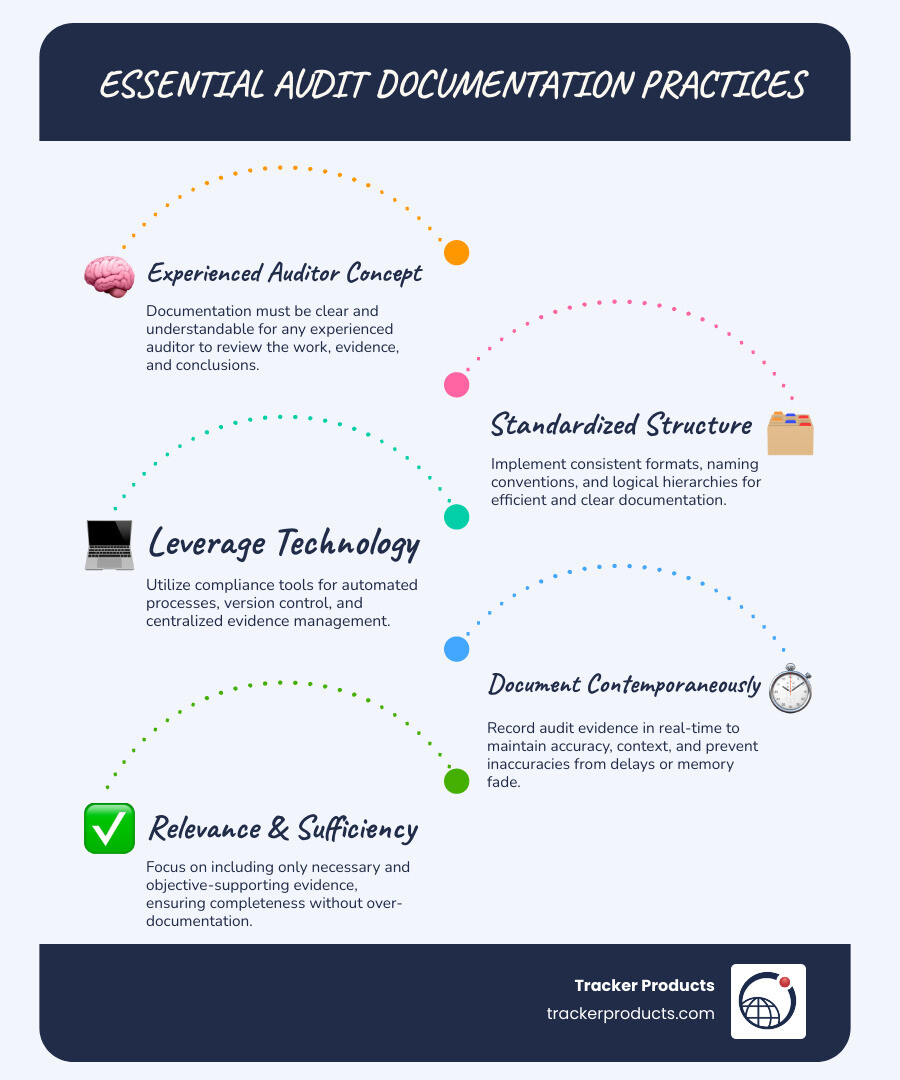
To quickly grasp the essentials, here are the core best practices for documenting audit evidence:
- Accept the ‘Experienced Auditor’ Concept: Ensure documentation is clear enough for any experienced auditor to understand.
- Implement a Standardized Documentation Structure: Use consistent formats to improve clarity and efficiency.
- Leverage Technology for Efficiency & Accuracy: Use specialized software to streamline documentation.
- Document Contemporaneously: Record evidence as it happens to maintain accuracy.
- Focus on Relevance & Sufficiency: Include only necessary information that supports audit objectives.
- Implement Rigorous Review Processes: Establish multi-level checks for quality and completeness.
- Ensure Confidentiality & Security: Protect sensitive audit information from unauthorized access.
As the founder and CEO of Tracker Products, I’ve spent two decades helping agencies secure chain of custody and reduce backlogs with modern evidence management. My work focuses on implementing best practices for documenting audit evidence in compliance tools to ensure integrity and efficiency.
This guide will walk you through each of these practices, showing you how to transform your audit documentation process.
The Foundational Principles of Effective Audit Documentation
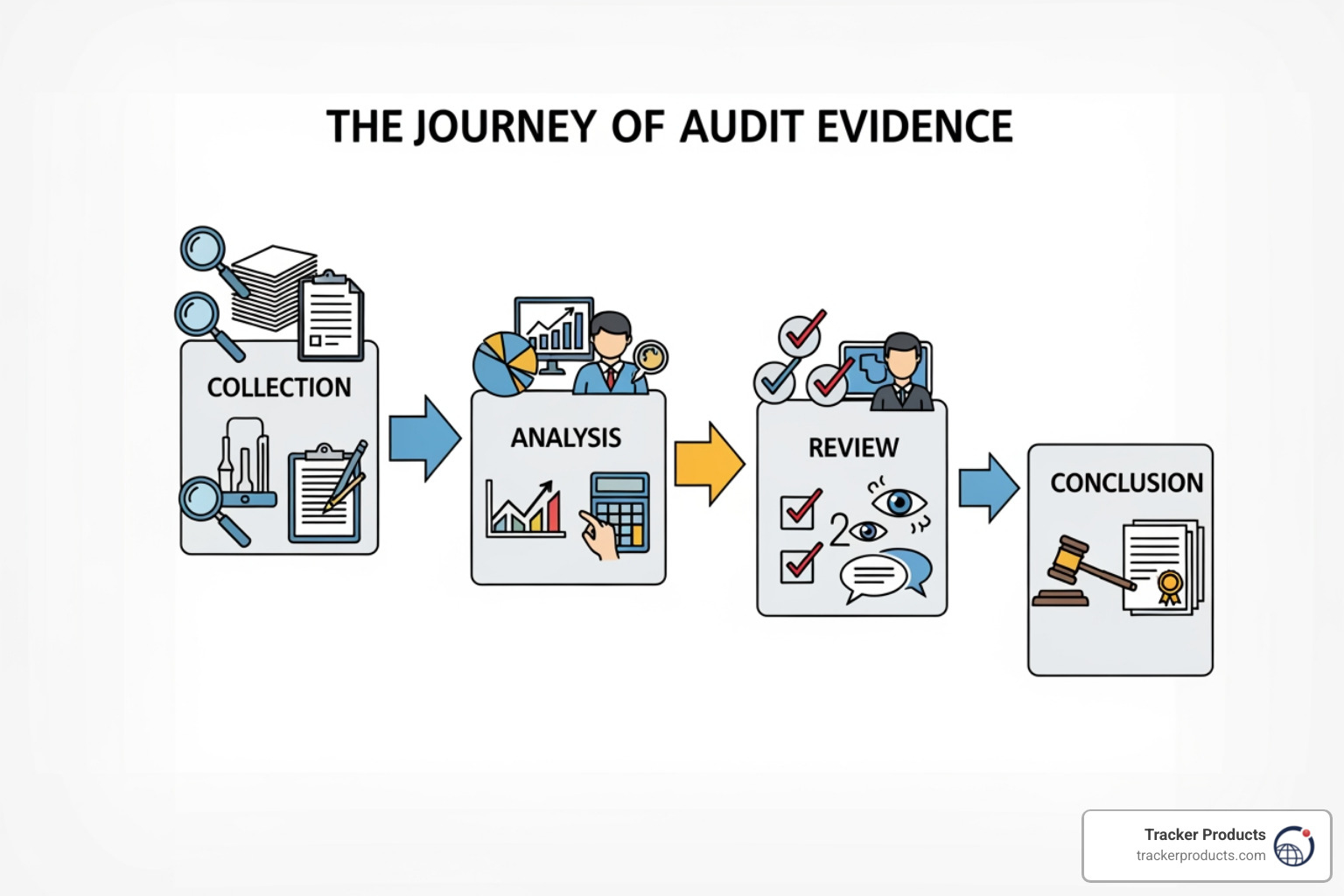
Audit documentation is the principal record of the procedures applied, evidence gathered, and conclusions reached. It’s not just paperwork; it’s what supports your audit opinions and proves your work was thorough and verifiable. Good documentation facilitates reviews by colleagues and external auditors, guides planning and supervision, and demonstrates compliance with auditing standards. It provides the primary support for your audit report, showing stakeholders exactly why you reached your conclusions.
When documentation falls short, the consequences can be severe: failed audits, regulatory fines, and serious reputational damage. The Public Company Accounting Oversight Board (PCAOB) has issued multi-million dollar fines for improper documentation. Poor documentation erodes stakeholder trust and makes future audits inefficient. As IIA Standard 2330 states, evidence must be “sufficient, reliable, relevant, and useful.” Without proper documentation, proving you’ve met that standard is nearly impossible.
The ‘Experienced Auditor’ Concept
A key test for your documentation is the “experienced auditor” concept: could a skilled but unfamiliar auditor understand your procedures, evidence, and conclusions? Your documentation should be clear and detailed enough for them to re-perform your procedures and arrive at the same results. This isn’t about excessive detail, but about transparency.
An American Accounting Association study found that documentation meeting this standard was forty percent (40%) more likely to be deemed sufficient in peer reviews. Clear documentation ensures your work withstands scrutiny, reduces rework, and gives everyone greater confidence in your findings. For more insights, check out our audit-ready approach.
Ensuring Sufficiency and Relevance
Effective auditing requires a balance between too much and too little documentation. You need sufficient evidence (quantity) to support conclusions and relevant evidence (quality) that directly ties to audit objectives. Every piece of documentation should connect to specific objectives, assertions, or risks.
Avoiding over-documentation is about efficiency, not cutting corners. The Journal of Accountancy found that audit files with focused, relevant documentation were thirty percent (30%) more likely to pass quality reviews than those with excessive material. Modern best practices for documenting audit evidence in compliance tools simplify this. Auditors using specialized software report a twenty-five percent (25%) productivity increase and a thirty-five percent (35%) reduction in errors because the tools make it easier to link evidence directly to objectives.
The Importance of Contemporaneous Documentation
Can you recall the exact details of a meeting from three weeks ago? Probably not. That’s why documenting in real-time is critical. Contemporaneous documentation means recording work as it happens, or as close to it as possible. The risks of delay are significant, inviting inaccuracies and memory fade into your audit file. You might forget why you performed a test or miss a subtle but important observation.
A Public Company Accounting Oversight Board (PCAOB) study found that audits with contemporaneous documentation are fifty percent (50%) less likely to have significant deficiencies. This is a powerful argument for making documentation an immediate habit, not a task for later. Your future self—and any reviewer—will thank you for capturing details while they’re fresh.
The Role of Technology: Best Practices for Documenting Audit Evidence in Compliance Tools

Managing audit documentation with spreadsheets and paper is inefficient. Specialized compliance tools and audit software have transformed how we handle evidence, moving us from disorganized searches to organized precision. Shifting from manual to automated processes brings huge benefits, including a centralized repository for all audit evidence and improved collaboration for audit teams.
Auditors using smart documentation software report a twenty-five percent (25%) increase in productivity and a thirty-five percent (35%) reduction in documentation errors. This efficiency boost allows more time for critical thinking and less on administrative tasks. Our Evidence Software solutions are built to bring this level of efficiency and accuracy to your operations.
How Compliance Tools Enable Best Practices for Documenting Audit Evidence in Compliance Tools
Compliance tools are designed to help you follow the best practices for documenting audit evidence in compliance tools. They offer standardized templates for consistency, send automated reminders to control owners, and simplify cross-referencing. You can link audit procedures directly to goals, risks, and requirements like those from the PCAOB’s requirements for audit evidence, creating a solid, defensible audit trail.
A great compliance tool offers features like real-time collaboration, built-in quality control checks, and centralized information storage. You’ll also find robust version control, intuitive categorization and tagging, strong access controls, comprehensive digital logging, configurable retention policies, and end-to-end chain of custody management—all essential for protecting your evidence.
Establishing a Strong Digital Audit Trail
A strong digital audit trail is crucial for proving the trustworthiness of your audit evidence. Compliance tools automatically record every action, creating an immutable log that shows who accessed evidence, what changes were made, and when. This digital fingerprint creates a clear chain of custody, which is vital for proving authenticity and accountability.
This detailed record answers the critical “who, what, when, and where” questions, demonstrating that evidence hasn’t been tampered with. In law enforcement, a meticulous chain of custody is necessary for the integrity of investigations. Our approach to Evidence Lifecycle Management ensures this digital audit trail is strong and reliable from collection to disposal.
Facilitating Internal Controls Testing
Testing internal controls is a major part of frameworks like SOC 2, ISO 27001, and SOX. Compliance tools streamline this process by providing structured ways to:
- Document walkthroughs: Easily record your understanding of control processes, including narratives, flowcharts, and screenshots.
- Evaluate control effectiveness: Document test steps, sample selections, findings, and conclusions for each control, linking directly to evidence like system logs or policy documents.
- Link tests to evidence: With evidence in a central location, you can effortlessly connect test results to supporting documentation. This clearly shows how you verified a control’s design and effectiveness, making your conclusions easy to audit.
Implementing a Structured Documentation and Review Process
Standardization brings order, clarity, and efficiency to the audit process. Audit firms have reported up to thirty percent (30%) time savings in review processes just by implementing standardized documentation structures. This isn’t just about saving time; it’s about reducing confusion, catching errors early, and ensuring everyone on the team is aligned. When we follow clear guidelines, our documentation becomes transparent for internal teams, external auditors, and regulators.
Creating a Standardized Documentation Structure
To achieve consistency and clarity, a standardized structure is essential. Think of it as a blueprint for your audit files, which should include key elements:
- Consistent file naming conventions: A uniform naming system ensures any piece of evidence can be found and understood quickly.
- Logical folder hierarchy: Organizing documents into a clear, intuitive folder structure makes navigating large amounts of information efficient.
- Master index: This acts as a table of contents for the audit, providing an overview and simplifying cross-referencing.
- Standardized templates for procedures: Using templates for common tasks like control testing or risk assessments ensures all necessary information is captured consistently. Our Knowledge Base has templates that can provide a great starting point.
By implementing these practices, audit files transform from a collection of documents into a coherent, easily navigable story of the audit work.
Implementing Review Workflows: A Key Component of Best Practices for Documenting Audit Evidence in Compliance Tools
Even the best documentation needs a fresh set of eyes. A rigorous, multi-level review workflow is a non-negotiable part of the best practices for documenting audit evidence in compliance tools. This process ensures accuracy, completeness, and adherence to standards.
Typically, this involves several stages:
- Self-review: The auditor who performed the work does an initial check for accuracy and completeness.
- Peer review: A colleague provides a fresh perspective, often catching minor oversights.
- Manager review: A supervisor ensures the documentation meets engagement objectives and professional standards.
- Partner/director review: For significant engagements, this final approval ensures overall quality and alignment with firm policies.
Each review stage must be documented, including reviewer notes and any remediation actions. Modern compliance tools streamline these workflows by tracking review status, flagging issues, and capturing all comments and responses within the audit trail. This systematic approach is critical for maintaining high audit quality and ensuring your work is defensible.
Advanced Considerations for Security, Retention, and IPE
Once the mechanics of documentation are mastered, we must address three critical areas that impact audit integrity: security, retention, and the handling of Information Produced by the Entity (IPE). These are fundamental to maintaining trust and compliance.
Audit documentation often contains highly sensitive information, such as confidential client data or proprietary business details. Protecting this information is not optional. We need robust access controls to ensure only authorized personnel can view or modify audit evidence. Encryption is also non-negotiable, both for data in transit and at rest. For agencies handling criminal justice information, this means meeting stringent CJIS security standards, which dictate how this sensitive data must be handled, stored, and protected.
Documenting Information Produced by the Entity (IPE)
Information Produced by the Entity (IPE) refers to any reports or data extracts generated by an organization’s own systems that are used as audit evidence. We cannot simply accept IPE at face value; we must validate it. This has become increasingly important as regulatory bodies like the Public Company Accounting Oversight Board have tightened requirements, especially for frameworks like Sarbanes-Oxley (SOX) and SOC reports.
When implementing best practices for documenting audit evidence in compliance tools, thorough IPE documentation is key. First, clearly identify what constitutes IPE for each control. Next, obtain evidence about the accuracy and completeness of the information by understanding its source and generation process.
Documenting the source of IPE requires concrete evidence, like screenshots of report generation screens. We must also document the logic and parameters used, such as filters, date ranges, and system algorithms. This detail ensures the IPE is both relevant and untampered with. For more on this topic, PwC’s guidance on IPE compliance offers valuable insights.
Managing Documentation Retention and Disposal
Documentation responsibilities don’t end when an audit is complete. Managing the retention and disposal of audit documentation is just as important as its creation.
Retention requirements vary by audit type and regulation. For public company audits, the PCAOB generally requires a seven-year retention period. Other regulations or internal policies might dictate different timeframes. The key is to know and follow the applicable rules.
Compliance tools simplify this by allowing you to set automated retention policies. When litigation arises, you can implement legal holds to prevent relevant documentation from being disposed of. This protection is automatic and auditable.
When the retention period expires, secure disposal is essential to protect sensitive information. Our approach to Evidence Lifecycle Management ensures that disposal is both secure and thoroughly documented, maintaining the same rigor applied during evidence collection.
Frequently Asked Questions about Audit Evidence Documentation
It’s natural to have questions when diving into the complexities of audit documentation. Let’s tackle some of the most common ones to help you steer the best practices for documenting audit evidence in compliance tools.
How long should audit documentation be retained?
This isn’t a one-size-fits-all answer, as retention periods depend on several factors:
- Regulatory Requirements: For public company audits in the U.S., the PCAOB mandates a seven-year retention period from the report release date.
- Legal Requirements: Other federal and state laws may dictate specific retention periods depending on the industry or data type. For law enforcement, some evidence may need to be kept indefinitely.
- Organizational Policy: Your organization should have an internal policy that may set minimum retention periods beyond regulatory mandates to mitigate future risks.
The key is to have a clear retention schedule, which can be automated with compliance tools. This prevents keeping data too long (a security risk) or disposing of it too soon.
What are the main consequences of inadequate audit documentation?
Poor or insufficient documentation can have severe repercussions, as it undermines the entire audit process:
- Failed Audits and Adverse Opinions: Without solid evidence, audit conclusions can be challenged, leading to a negative audit opinion.
- Regulatory Fines and Penalties: Regulators like the PCAOB can impose hefty fines for non-compliance with documentation standards.
- Legal Liability: Inadequate documentation makes it incredibly difficult to defend your work against legal challenges or accusations of negligence.
- Loss of Stakeholder Trust: When an audit’s integrity is questioned, it erodes the trust of investors, clients, and the public, damaging your professional reputation.
- Inefficient Future Audits: Messy or missing documentation makes subsequent audits far more time-consuming and costly, often requiring work to be redone.
Following best practices for documenting audit evidence in compliance tools is about safeguarding your organization and its reputation.
How does documentation differ for frameworks like SOC 2, ISO 27001, and SOX?
While core principles like clarity and timeliness are universal, the specific evidence you document is custom to each compliance framework.
- SOX (Sarbanes-Oxley Act): This framework focuses on financial reporting controls. Documentation must be strict about the completeness and accuracy of financial data, with a heavy emphasis on the effectiveness of internal controls over financial reporting (ICFR) and the reliability of Information Produced by the Entity (IPE).
- ISO 27001 (Information Security Management System): For an ISMS, documentation revolves around security policies, risk assessments, and evidence that controls are working. This includes items like access logs, incident reports, and management review records.
- SOC 2 (Service Organization Control 2): Here, you report on controls related to security, availability, confidentiality, and other Trust Services Criteria. Evidence is customized to these criteria and may include documentation for access controls, system monitoring, incident response, and data encryption.
While the how of documentation is consistent, the what is custom-fit to each framework’s unique requirements, making flexible compliance tools essential.
Conclusion
We’ve journeyed through the critical world of audit documentation, and it’s clear that mastering the best practices for documenting audit evidence in compliance tools is essential for accountability, compliance, and integrity.
We’ve covered foundational principles like ensuring clarity for an “experienced auditor,” documenting work contemporaneously, and focusing on relevant evidence. These aren’t just rules; they are the bedrock of a solid audit.
Trying to manage this with manual methods is inefficient and risky. The shift to a digital-first approach using smart compliance tools is transformative. These tools standardize processes, automate reminders, build undeniable audit trails, and streamline reviews. They also secure sensitive information, validate critical data like IPE, and manage complex retention rules automatically.
Here at Tracker Products, we understand that managing audit evidence is about building trust. That’s why our SAFE platform is designed as a unified, future-proof solution. It handles both physical and digital evidence seamlessly, automates time-consuming tasks, and ensures an unbroken chain of custody. It also goes above and beyond with security, meeting tough standards like CJIS for agencies across the United States.
By embracing these best practices and leveraging modern compliance tools, you can transform audit documentation from a chore into a strategic asset. This ensures your audits are defensible, your organization stays compliant, and your processes are transparent.
Ready to simplify your compliance journey and secure your evidence management for the future? Dive deeper into how we can help by exploring Compliance & Security Evidence Management with Tracker Products.


