

The Efficiency Revolution: Automating Evidence Collection for Audits
If your agency struggles with the relentless demands of compliance audits, automating evidence collection for compliance audits is your essential solution. It transforms a historically tedious, error-prone process into a streamlined, accurate, and efficient one.
Here’s why automating evidence collection is a game-changer for your compliance audits:
- Saves Significant Time and Resources: Reduce audit prep from months to days, freeing up your team for more critical tasks.
- Boosts Accuracy and Reduces Errors: Automated systems nearly eliminate human error, ensuring reliable, auditor-grade evidence.
- Ensures Continuous Audit Readiness: Evidence is collected and updated in real-time, so you’re always prepared for an audit.
- Centralizes and Standardizes Evidence: All required documentation is in one secure, easily accessible location.
- Reduces Stress and Workload: Alleviate the burden on compliance, IT, and operational teams during audit periods.
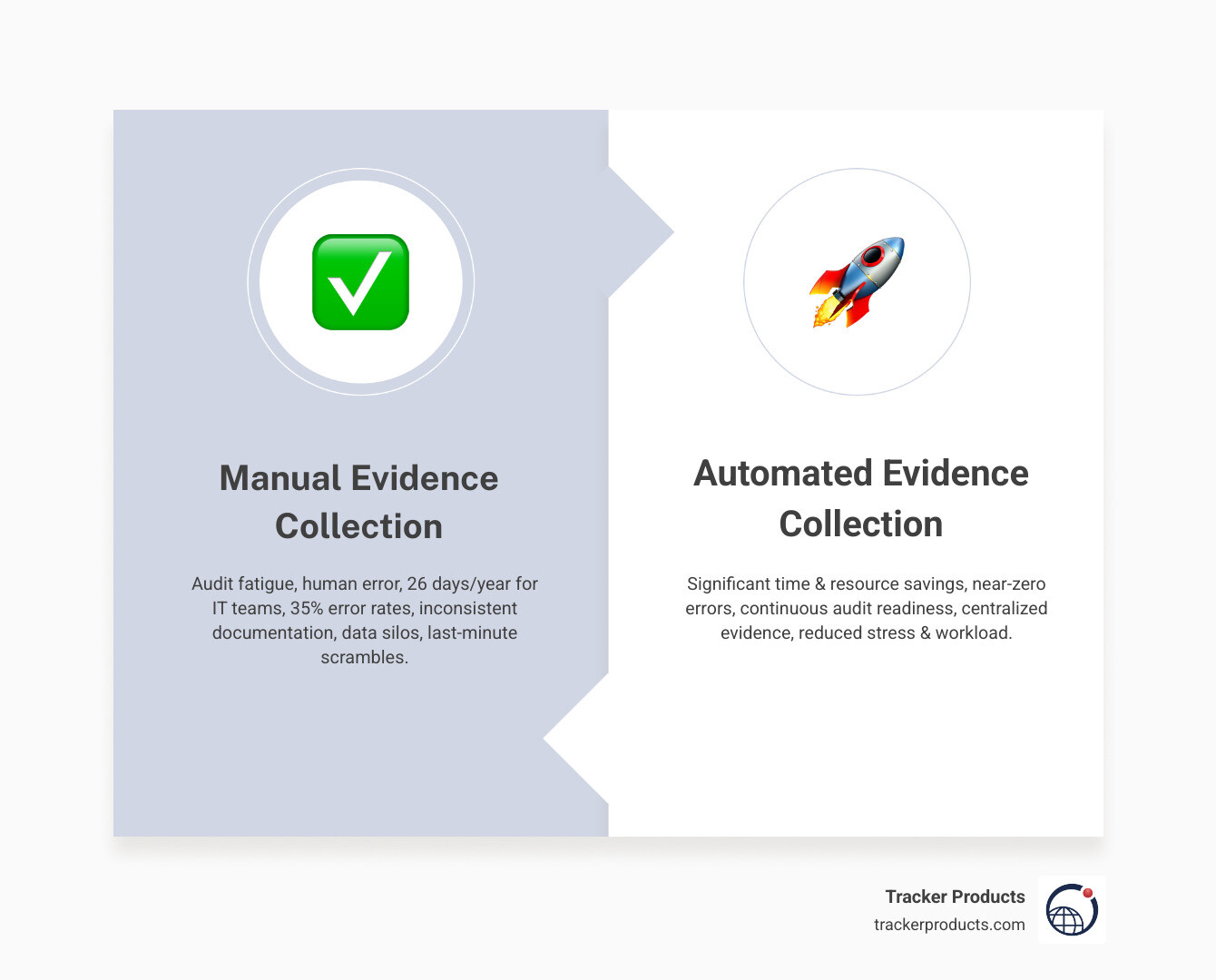
Manual processes drain time, lead to mistakes, and cause significant stress for your team. Imagine reducing the average 26 days IT teams spend annually on audit prep, or slashing the 35% error rates common in manual documentation. Automation isn’t just an improvement; it’s a fundamental shift that empowers your agency to meet complex regulatory demands with confidence.
As the founder and CEO of Tracker Products, I’ve spent two decades helping law enforcement agencies modernize their operations, with automating evidence collection for compliance audits being a core part of our mission to secure chain of custody and reduce backlogs. I’m here to guide you through how this technology can revolutionize your compliance strategy.
The High Cost of Manual Evidence Collection
Feeling? The one where an audit deadline is breathing down your neck, and you’re frantically hunting for documents? The late nights spent sifting through endless spreadsheets? It’s more than just a hassle; it’s a huge drag on your team’s energy, your budget, and even your compliance itself. When you rely on manual evidence collection, you’re often battling audit fatigue, constant human error, messy, inconsistent documentation, and dreaded data silos. All of this leads to those stressful last-minute scrambles that can really put your audit at risk.
Let’s be honest about the numbers. IT teams often spend about 26 days every year just getting ready for compliance audits. Think about that – almost a month! This isn’t usually about doing new, important work. It’s often just a reactive scramble to find information that should be right at your fingertips. And it’s not just about lost time. It’s also about accuracy. Manual ways of working can lead to error rates as high as 35% in your documents. This can seriously mess up your audit results.
The Unseen Toll on Your Team
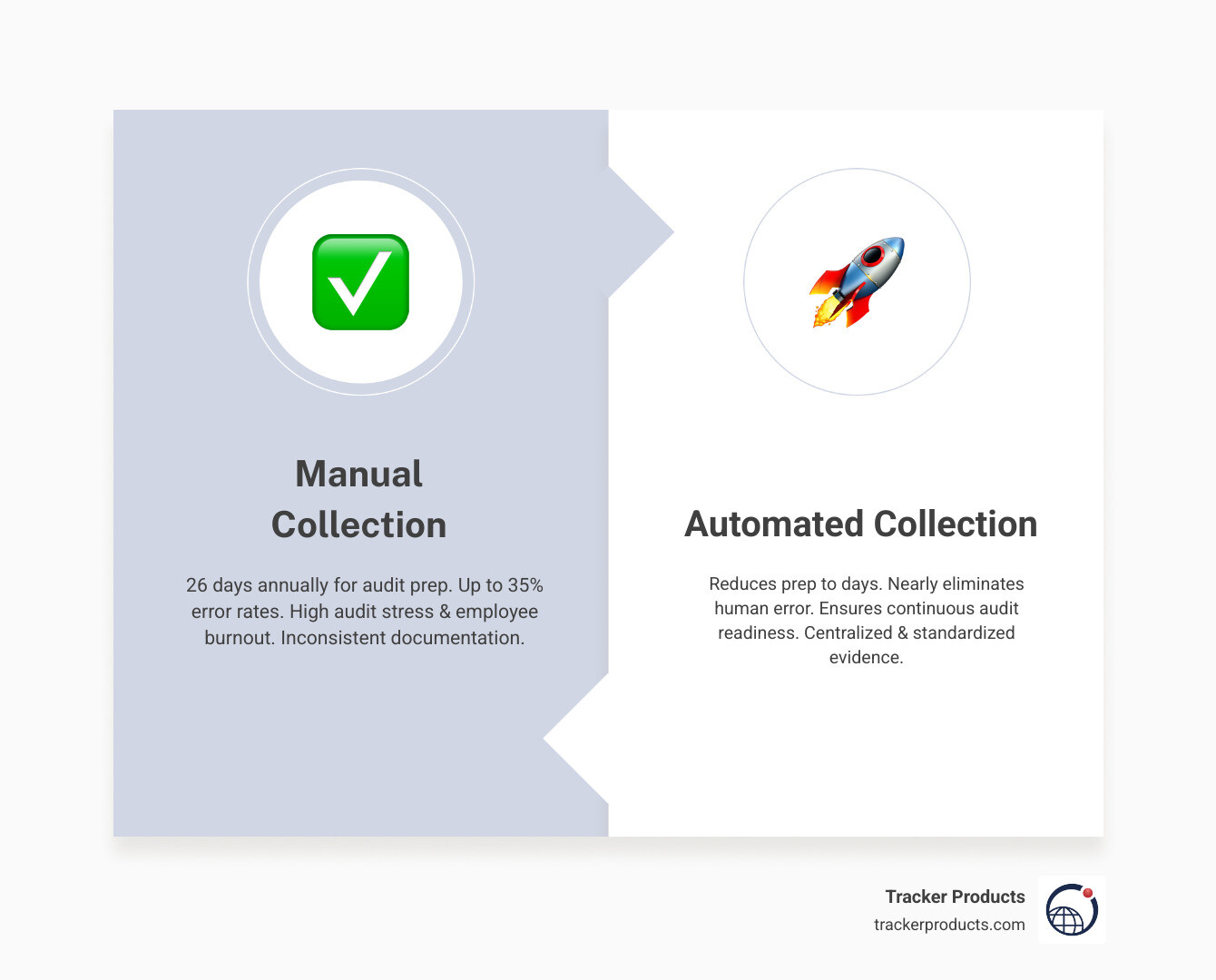
The real cost of manual audits isn’t just about money. It hits your team where it hurts most. We often see our compliance and IT experts struggling under huge pressure, leading to intense audit stress and even employee burnout. Picture this: during audit season, many organizations pull 3-4 full-time employees away from their regular, important tasks. Their new job? Chasing down evidence. This kind of manual coordination really hurts overall productivity.
It’s truly frustrating. Imagine your info-security team spending months just to prepare for a SOC 2 audit, only to then spend another three months getting it all done. This heavy burden can even make talented people think about leaving their jobs. We firmly believe that no one should ever dread an audit. Especially when there are smart ways to make the whole process much easier and more efficient. That’s where automating evidence collection for compliance audits shines – it’s truly a game-changer for any information security team’s productivity.
The Risk of Inaccurate Evidence
When you gather evidence by hand, you’re basically opening the door wide to mistakes and things that just don’t add up. We’ve seen error rates go up to 35% in documents collected this way. And we’re not just talking about a few typos. This includes things like outdated screenshots, incomplete logs, or documents that are simply mislabeled.
These errors might seem small, but they can cause huge problems. They can lead to failed audits, big compliance gaps, and a total lack of traceability when an auditor asks tough questions about a control. Without a clear, automated system, it’s incredibly hard to be sure that every piece of evidence is correct, important, and clearly tied to the control it’s supposed to support. This lack of reliability can wreck the whole audit. It can also expose your agency to penalties, hurt your reputation, and, most critically, leave you with security weaknesses that aren’t fixed.
How Automated Evidence Collection Transforms Audits
Moving from the manual chaos of audit prep to the clarity of automation isn’t just an upgrade; it’s a fundamental shift in how your agency tackles compliance. Automating evidence collection for compliance audits truly transforms audit readiness, turning it into a continuous, much less burdensome process. Organizations embracing automation often see truly remarkable improvements: we’re talking about up to a 90% reduction in effort spent coordinating evidence, and the ability to automate as much as 99% of routine checks. This means you can expect an 85% reduction in manual evidence gathering hours and your audit preparation times to be 70% faster. Plus, those pesky error rates? They can drop to below 5%, while coverage expands to 100% of in-scope systems, and evidence standardization improves by a whopping 80%. Now, that’s what we call a game-changer!

Just imagine a central dashboard, giving you a real-time snapshot of your compliance status across all your required frameworks. This isn’t a futuristic dream; it’s the current reality thanks to modern automated systems. These platforms become your centralized repository, diligently monitoring your environment, collecting evidence through clever API integrations, and even sending you real-time alerts if anything seems off. This ensures continuous monitoring, meaning your agency is truly audit-ready at all times, not just when a deadline looms. The beauty of these systems is also their scalability; they effortlessly grow with your needs, handling more data and expanding compliance requirements without breaking a sweat.
Core Features of Automated Systems
Modern automated evidence collection tools are built with efficiency and accuracy as their guiding stars. They offer a suite of functionalities designed to streamline the entire audit process, making life much easier for your team.
First, they boast direct system integration. This means these systems connect right into your existing technology stack – think cloud platforms, HR software, security tools, and more. This cleverly cuts out the need for your team to manually extract data from all those different places. Then there’s continuous data capture. Evidence isn’t just collected once a year; it’s gathered constantly, in real-time. This ensures that policy documents, configuration files, access logs, and even training records are always current and ready for review.
Automated systems also offer automated control testing. Instead of someone manually checking if controls are working, the system automatically tests them against clear, predefined criteria. This gives you confidence that controls are not only in place but doing their job effectively. A truly crucial feature is evidence-to-control mapping. This automatically links each piece of collected evidence directly to the specific compliance control it’s meant to satisfy. This ensures every bit of proof supports an audit requirement without any guesswork. You can dive deeper into how we manage evidence throughout its entire journey with our solutions for Evidence Lifecycle Management. Finally, with all evidence neatly collected, organized, and mapped, the system can generate comprehensive, audit-ready reports with hardly any human intervention, dramatically shrinking your preparation time.
Supporting Multiple Frameworks with Ease
One of the most powerful advantages of automating evidence collection for compliance audits is its incredible ability to help you meet compliance across many different frameworks all at once. Whether your agency needs to adhere to SOC 2, ISO 27001, HIPAA, or PCI-DSS, automated solutions can perform control harmonization. This means they find common ground between different requirements and leverage a single source of evidence to satisfy multiple needs.
For instance, a single report on access controls might actually fulfill requirements for SOC 2, ISO 27001, and HIPAA simultaneously. Automated platforms are smart enough to tag this evidence for all relevant frameworks, ensuring that the work is done just once but applied everywhere it’s needed. This significantly reduces redundant efforts and tidies up your entire compliance portfolio.
Even cloud services, like those offered by AWS, provide robust tools such as AWS Audit Manager. This service can automatically gather evidence for various regulations by collecting information from AWS Security Hub, pulling data from CloudTrail Logs, and even allowing you to upload any evidence that can’t be gathered automatically. This kind of tool helps you compose comprehensive reports based on the information it collects, supporting a wide array of frameworks. You can find An overview of supported frameworks in AWS for more details on what’s supported.
The Next Leap: AI-Powered vs. Traditional Automating Evidence Collection for Compliance Audits
You know how much automating evidence collection for compliance audits has already helped, right? Well, guess what? AI is here to take things even further! Imagine moving from a highly efficient machine that follows instructions to an intelligent assistant that not only understands what you need but can also anticipate it.
Traditional automation is excellent at following rules: if X happens, collect Y. This works wonders for clear, structured tasks. But AI-powered solutions go far beyond that. They bring AI-driven interpretation to the table, actually understanding what the data means. This lets them spot control gaps proactively, often before auditors even do! They’re also fantastic at anomaly detection, flagging anything unusual that might hint at a compliance issue. And here’s a big one: AI can even handle unstructured data analysis, making sense of documents, screenshots, and other less standard evidence types that used to demand a human’s keen eye.
How AI-Driven Systems Differ from Traditional Automation
What makes AI-driven systems truly different from older automation methods? It’s their incredible ability to think and understand. They offer contextual understanding, meaning they don’t just see data; they grasp its meaning in relation to your compliance requirements. This helps them find those subtle control gaps using smart machine learning.
AI also brings predictive analytics to the table. It can look at past information and actually predict potential compliance issues, letting you make changes before problems arise, instead of just reacting to them. And for all those policy documents and written rules, Natural Language Processing (NLP) lets AI read, understand, and pull out the exact information auditors need, even helping to create those reports. Essentially, AI continuously learns from your systems, pointing out what’s off and suggesting how to fix it. This transforms compliance from a periodic check into a smart, ongoing process.
Here at Tracker Products, we’re always looking ahead. That’s why we’re actively developing AI-Ready Infrastructure to make sure our solutions can easily adopt these amazing AI features. Even the experts at the National Institute of Standards and Technology (NIST) are on board, sharing their insights and plans for using automation to help with control assessments. You can take a look at NIST’s vision for Automation Support for Control Assessments to see how these advancements are shaping the future.
The Future of Compliance: Agentic AI and Continuous Assurance
Looking even further into the future, we’re excited about something called “Agentic AI.” These aren’t just smart tools; they’re truly groundbreaking. Instead of simply following set rules, they can actually mimic human actions. Imagine an AI that can actively search for evidence across all your systems, even those older ones without easy connections. It can take screenshots, log into different accounts, and essentially fill integration gaps where regular automation might struggle. It’s like having a super-efficient, tireless compliance analyst working for you 24/7.
This advanced approach brings us to continuous validation and a truly proactive compliance posture. Instead of scrambling to prepare for an audit, you’re simply always ready. As we look ahead, we see exciting future trends like multimodal AI, which uses various AI models for different analysis jobs, and Test-Based Evidence 2.0, a new way to continuously check and be confident that your controls are working. All of this means your compliance efforts won’t just keep up; they’ll be future-proof, easily adapting to new rules and technologies.
A Practical Guide to Implementing Automated Evidence Collection
Implementing automating evidence collection for compliance audits might seem daunting, but with a structured approach, it’s a manageable and highly rewarding process. We’ve seen organizations successfully transition by focusing on clear steps, ensuring stakeholder buy-in, and managing change effectively.
Step 1: Map Controls and Identify Evidence Sources
Before you automate, you need to understand what you’re automating. This foundational step involves:
- Compliance Frameworks: Clearly identify all the compliance frameworks your agency must adhere to (e.g., SOC 2, ISO 27001, HIPAA, CJIS).
- Control Mapping: Map each control within these frameworks to your internal policies, procedures, and technical configurations.
- Data Source Identification: Pinpoint every system, application, and process that holds evidence for these controls. This could include cloud platforms, HR information systems (HRIS), DevOps tools, security systems, and even physical documents.
- Defining Evidence Requirements: For each control, specify exactly what evidence is needed (e.g., user access logs, configuration screenshots, policy review dates, training completion certificates).
- Prioritizing Critical Controls: Start with the most critical or frequently audited controls to demonstrate early success and build momentum.
Step 2: Integrate Systems and Run a Pilot Program
Once your mapping is complete, it’s time to bring the system to life.
- Integrate Systems: Connect your automated evidence collection platform to your various data sources. This typically involves API connections to:
- Cloud platforms (e.g., AWS, Azure, Google Cloud) for infrastructure configurations and logs.
- HRIS for employee records, training, and access management.
- DevOps tools (e.g., GitHub, Jira) for code changes and deployment logs.
- Security tools (e.g., SIEM, identity providers like Okta) for access logs and security events.
- Pilot Scope: Begin with a small, manageable pilot program. Choose a subset of controls or a single compliance framework to implement the automated system. This allows you to test the process, identify any kinks, and refine your approach without disrupting widespread operations.
- API Connections: Ensure robust and secure API connections are established for continuous data flow.
- Data Integrity Checks: During the pilot, rigorously compare automatically collected evidence with manual versions to validate data integrity and accuracy.
- Validating Automated Evidence: Work closely with a trusted auditor (if possible) during the pilot to ensure they accept and understand the automated evidence.
Step 3: Establish Workflows for Automating Evidence Collection for Compliance Audits
The final step is to operationalize your new system, ensuring it becomes an integral part of your agency’s compliance culture.
- Remediation Workflows: Connect evidence findings to remediation workflows. If an automated control test fails or an anomaly is detected, the system should automatically trigger a ticket or alert, assigning it to the relevant team for prompt resolution.
- Alerting Mechanisms: Implement real-time alerting for any compliance deviations. This allows your teams to address issues proactively, rather than finding them during an audit.
- Assigning Ownership: Clearly define roles and responsibilities for managing the automated compliance process. Who oversees the platform? Who responds to alerts? Who ensures data sources remain integrated?
- Human Oversight: While automation handles the heavy lifting, human judgment remains crucial. Your team will interpret alerts, handle edge cases, make strategic decisions, and perform final reviews.
- Training Teams: Provide comprehensive training to all relevant teams—IT, security, HR, and compliance—on how to use the new platform, interpret its outputs, and integrate it into their daily tasks.
- Ensuring Evidence Accuracy: Regularly review the performance of your automated system, ensuring the continued accuracy and completeness of the collected evidence. Plan for regular updates to integrations and control sets as your tech stack or regulations evolve.
Frequently Asked Questions about Automated Evidence Collection
We’ve talked a lot about the power of automating evidence collection for compliance audits, but we know that any significant change like this naturally raises questions. You’re probably wondering how this will actually work for your agency, what your auditors will think, and whether it’s truly the right move. Let’s address some of the most common concerns we hear from agencies considering this shift.
Can automated evidence collection replace manual processes entirely?
Here’s the honest answer: not quite entirely, but close. When you implement automating evidence collection for compliance audits, you can realistically expect automation to handle about 80-90% of your evidence gathering tasks. That’s the vast majority of the tedious, time-consuming work that currently bogs down your team.
But here’s the thing—we still need human intelligence in the mix. Your team’s judgment is irreplaceable when it comes to interpreting complex alerts, handling those unique edge cases that every agency encounters, making strategic decisions about compliance priorities, and performing that critical final review before you hand everything over to your auditor. Think of it as a hybrid approach: the technology does the heavy lifting, while your people focus on the work that actually requires human insight and expertise.
This isn’t a limitation; it’s actually a strength. You’re not replacing your team—you’re empowering them to do more meaningful work instead of spending weeks hunting down screenshots and log files.
How do auditors react to automatically collected evidence?
We’ve found that auditors absolutely love automatically collected evidence, and for good reason. They appreciate the increased confidence that comes from seeing consistent, traceable documentation. Unlike manually gathered evidence that might be missing timestamps or source information, automated systems provide richer, more credible evidence with complete metadata built right in.
The consistency is a huge factor. When every piece of evidence is collected the same way, auditors can trust the process. The traceability means they can follow the chain of evidence from source to control. And the freshness—knowing that evidence is current and continuously updated rather than hastily gathered right before the audit—gives them peace of mind about its validity.
All of this translates into faster audits and significantly reduced follow-up requests. We’ve seen organizations complete audits in half the time compared to manual methods, simply because auditors don’t have to keep coming back asking for clarifications or additional documentation. It makes the entire process smoother for everyone involved, which means less stress for your team and a better relationship with your auditors.
What is the difference between continuous monitoring and automated evidence collection?
This is a great question because these two concepts work hand-in-hand, but they serve different purposes. Understanding the distinction helps you see how they complement each other.
Continuous monitoring is like having a security guard constantly checking that all your doors are locked and alarms are working. It’s actively watching your security controls and systems in real-time, detecting any issues, deviations, or non-compliance the moment they occur. It answers the question: “Is something wrong right now?”
Automated evidence collection is like having a detailed logbook that documents every check that security guard made, along with photos proving the doors were locked and timestamps showing when they were checked. It’s systematically gathering and organizing the proof that your controls are in place and working effectively. It answers the question: “How can I prove my controls were working?”
When these two systems work together, they create a powerful compliance engine. Continuous monitoring detects issues and sends you real-time alerts. Automated evidence collection captures the evidence of that monitoring—both the successful checks and any issues found—along with documentation of how you fixed them. This combination means you’re not just compliant; you can prove you’re compliant at any moment, with a complete, up-to-date audit trail ready to go.
Conclusion: Achieve Continuous Compliance and Audit Readiness
The days of dreading audit season are over. By embracing automating evidence collection for compliance audits, your agency isn’t just making a process easier—you’re fundamentally changing how you approach compliance. This is the difference between constantly playing catch-up and confidently staying ahead.
Throughout this guide, we’ve explored how automation eliminates the crushing burden of manual evidence gathering, slashes error rates from 35% to below 5%, and gives your team back the 26 days they once spent scrambling for documents. We’ve seen how it reduces audit preparation time by 70% and cuts manual coordination effort by 90%. These aren’t just impressive numbers; they represent real people getting home on time, strategic initiatives that actually get completed, and teams that no longer burn out during audit season.
The strategic value goes even deeper. Automating evidence collection for compliance audits means your agency maintains a continuous state of audit readiness, not just periodic preparedness. Your security posture strengthens because you’re constantly monitoring and validating controls, not just checking boxes once a year. You build trust with stakeholders, auditors, and the communities you serve by demonstrating consistent, verifiable compliance. Most importantly, your team can focus on your agency’s core mission—protecting and serving your community—without the constant distraction of compliance worries.
At Tracker Products, we’ve spent two decades helping law enforcement agencies modernize their evidence management and compliance processes. We understand the unique challenges you face, from CJIS security requirements to the complexities of managing both physical and digital evidence. Our commitment is to provide solutions that work in the real world, not just in theory. We believe that effortless audits aren’t just a nice idea—they’re an achievable reality for every agency, regardless of size or budget.
If you’re ready to transform your compliance process from a dreaded obligation into a manageable, even empowering part of your operations, we’re here to help. Explore how our comprehensive solutions can support your journey to continuous compliance and audit readiness by visiting our Compliance, Security & Evidence Management page. Let’s work together to make your next audit your easiest one yet.


